Estate acreage
Custom brick, stone, and stucco homes on three to ten acres — the defining Marvin product, typically $1.5M–$4M+.
Incorporated 1994
A deliberately planned village of five-acre minimums, pastoral setbacks, and one of the highest median household incomes in the Carolinas.
Population
≈ 7,800 residents
Median Price
≈ $1.4M median home price
Incorporated
1994
ZIP
28173
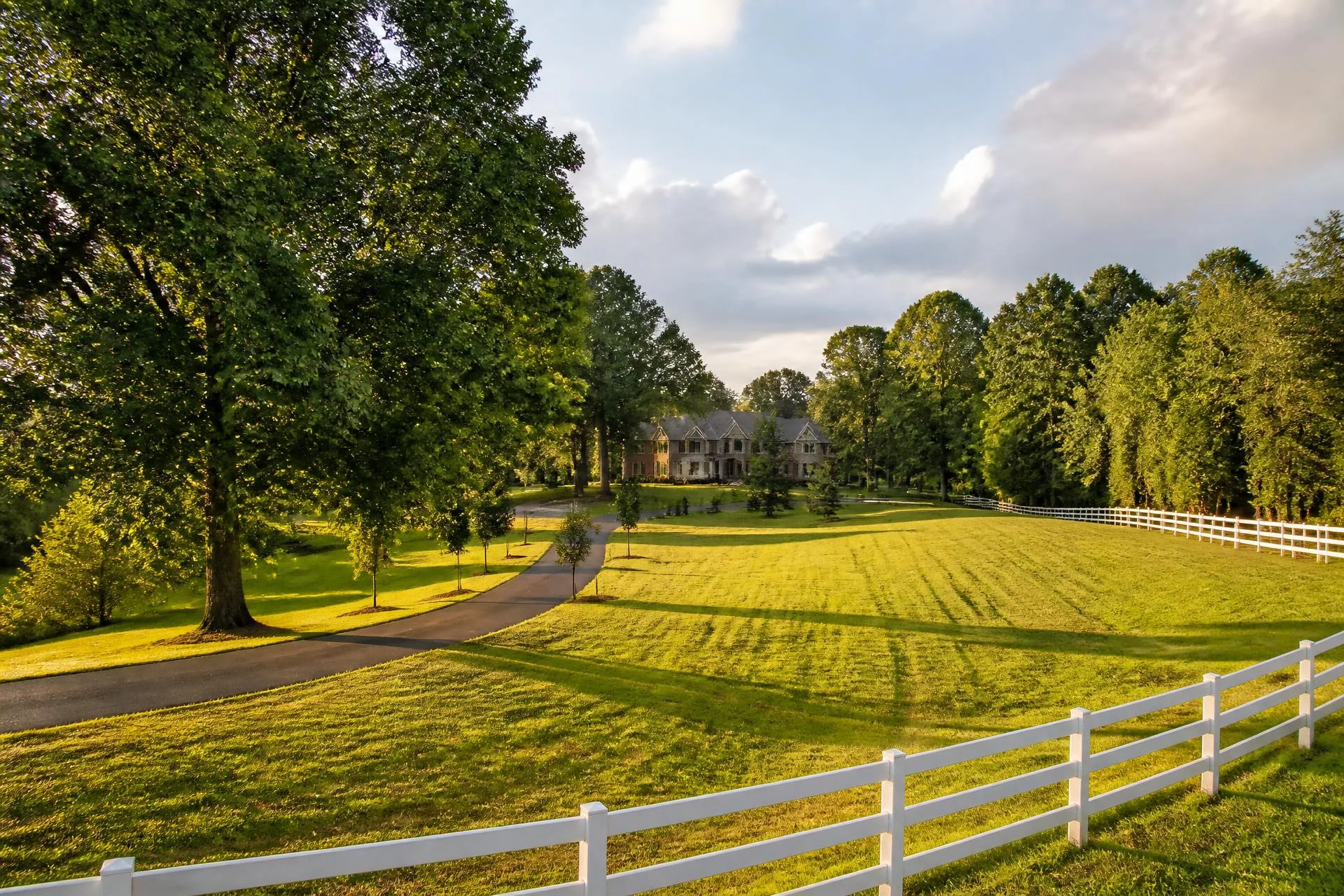
Marvin was incorporated in 1994 for a single reason: to control what would be built on it. Residents watched Charlotte's growth arrive at the Mecklenburg line and chose density limits over tax base. Thirty years later the decision is visible from any road in the village — long white fence lines, pasture between houses, and almost no commercial signage.
The result is the corridor's most consistent estate market. Homes sit far off the road on lots that in much of the metro would be subdivided four ways. Buyers here are typically trading square footage in south Charlotte for land, privacy, and the Marvin Ridge school catchment.
Marvin is also the closest of the corridor villages to the Mecklenburg line, which makes it the practical choice for households that need shorter drives to Ballantyne, SouthPark, or uptown without giving up acreage.
Character
Housing Stock
Custom brick, stone, and stucco homes on three to ten acres — the defining Marvin product, typically $1.5M–$4M+.
Marvin Creek, Wesley Oaks and similar neighborhoods deliver large traditional homes on one-acre-plus lots with lighter maintenance than true acreage.
Original family tracts occasionally come to market as land assemblages; these drive the village's highest per-acre pricing.
Schools
Marvin Elementary, Marvin Ridge Middle, and Marvin Ridge High form one of the highest-performing K–12 chains in Union County Public Schools and in North Carolina generally.
Marvin Ridge High's AP participation, test performance, and college placement are the single most cited reason buyers accept Marvin's price premium.
Because catchment lines determine access, buyers routinely verify the assigned school for a specific parcel before making an offer.
Getting Around
Neighborhoods
Traditional brick-and-stone transitional homes on generous lots.
Custom estate enclave with mature landscaping.
Established acreage neighborhood with equestrian-friendly parcels.
Gated community straddling the Marvin–Weddington identity.
What people ask
The questions below are the ones actually typed into search about Marvin — answered without hedging, and with the tradeoffs left in.
A deliberately planned village of five-acre minimums, pastoral setbacks, and one of the highest median household incomes in the Carolinas. In practice, Marvin, NC suits households that want Union County tax rates, the Union County Public Schools assignment and a median price around $1.4M median home price. The honest tradeoff is that everything here is driven by a car — the corridor rewards space and schools over walkability, with the exception of the historic downtown pockets.
Housing is the variable that matters: Marvin runs at approximately $1.4M median home price, against a corridor that spans restored cottages to multi-million-dollar gated estates. Union County's effective property tax rate sits among the more favorable in the Charlotte metro. Groceries, utilities and insurance track regional averages; the real line items to model are commute fuel, association dues and, for larger lots, well and septic maintenance.
10–15 minutes — the shortest of any corridor village.
The Marvin median sits at approximately $1.4M median home price, but that single number hides most of the story. Custom brick, stone, and stucco homes on three to ten acres — the defining Marvin product, typically $1.5M–$4M+. Compare within a feeder pattern and lot size before assuming a town premium explains a price gap.
The named neighborhoods buyers ask about most are Marvin Creek, Wesley Oaks, Kingsmead, Providence Downs. Each is set out street by street — architecture, lot size, association structure and school assignment — on the Marvin neighborhoods page.
Union County Public Schools: Marvin Elementary feeding Marvin Ridge Middle and Marvin Ridge High — one of North Carolina's most requested feeder patterns. Assignment is set at the parcel level and changes with redistricting, so verify a specific address rather than trusting a neighborhood name.
≈ 7,800 residents The town was incorporated in Incorporated 1994. Growth in this part of the region has consistently outrun road and classroom capacity, which is why attendance lines and intersection projects are revisited every few years. Buyers holding for a decade should read current land-use plans, not just current conditions.
Neither wins outright. Waxhaw brings the corridor's only genuinely walkable historic downtown and the deepest gated-estate inventory; Marvin brings much of the original village carries five-acre minimum lot sizing; even later subdivisions were platted at densities far below county norms. Run both against your own three constraints — commute, school pattern, and lot — and the answer usually stops being close.
Real estate
Discover Waxhaw is an editorial guide and publishes no listings. Live inventory for Marvin and the rest of the corridor is published through Canopy MLS and carried on the licensed brokerage and builder sites below. Start with the segment guides, then verify every address-specific item on the parcel record.
Listings
Peters & Associates publishes current luxury inventory across Marvin and the greater Charlotte region. Brokerage profile →
Building
Peters Custom Homes builds ground-up custom and estate homes in this corridor. Builder profile →
Finishing
Emerald & Oak handles interior design and furnishings for new builds and renovations. Studio profile →
Everyday Life
Questions
Marvin's zoning caps density — much of the village requires very large minimum lots — so supply is structurally limited while demand for the Marvin Ridge school catchment is high. Price per home reflects land as much as construction.
Marvin Elementary, Marvin Ridge Middle, and Marvin Ridge High, all within Union County Public Schools.
Roughly 30–45 minutes to uptown, and only 10–15 minutes to Ballantyne, making it the shortest commute of the Waxhaw-area villages.
Many Marvin parcels are large enough to permit livestock and private barns, and equestrian use is part of the village's character. Permitted use always depends on the individual parcel's zoning and any HOA covenants.